



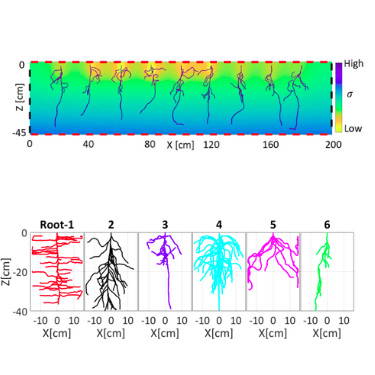
Research Question: Does electrical anisotropy contain information about root architecture?
Finding: Electrical anisotropy is a fingerprint of root organization — the first mechanistic proof that geoelectrical measurements encode 3D structural information.
Methodology:
- Generated synthetic root architectures using C-Rootbox (monocots vs. dicots)
- Computed direction-dependent conductivity tensors
- Extracted geometrical indices (convex hull, depth, width, tortuosity)
- Applied machine learning (PCA + k-NN classification)
Key Results:
- Magnitude component (low frequency): water uptake patterns
- Phase component (high frequency): root architecture directly
- Species discrimination: 95% accuracy using k-NN on electrical signatures alone
Publications: 2 conference papers (Geophysical Research Abstracts) Thesis Chapter: 4 Collaboration: Prof. Andreas Kemna (Bonn)